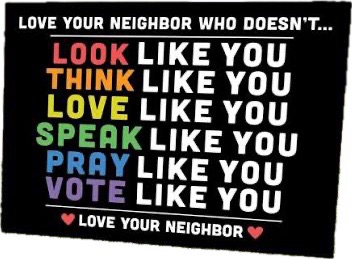
A question I see regularly. Here’s my take, as a Christian (who is routinely embarrassed by my fellow Christians’ misdeeds).
A lot of us are raised to believe, explicitly and fervently, that doubt is an existential THREAT. And even if we aren’t explicitly taught to hate and fear outsiders, it comes across implicitly in a number of our practices, beliefs, and philosophies.
Which makes sense, when you think about it. It’s human nature to form groups, and for millions of years, the only way we could survive was to stick with a group and view outsiders with wariness and treat them with hostility as needed.
To Christians, this is what atheists and practitioners of other faiths and even different denominations are: outsiders who present a potential threat.
Practically, this threat is rarely physical, although plenty of churches (particularly insular/conservative ones) preach that atheists, etc, intend to kill us all or take over the country or replace all “Christians” (they usually mean white people).
The threat is more psychological.
Many Christians believe the only way to be a moral, good person is to be a Christian.
Which is, of course, nonsense that I’ve spoken about before. But this implies that non-Christians are inherently immoral and potentially dangerous, and someone who’s been indoctrinated from an early age to believe that will often react poorly when presented with such a person. They will try desperately to convert that person or dismiss them, because of the deeper threat they pose.
The symbolic threat.
For you see, if a non-Christian is indeed moral, compassionate, sensible, even kind, that shakes them to their core. That’s supposed to be impossible, and the fact that it IS possible means their insular church LIED to them. And what else did they lie about?
Encountering a kind, moral, upstanding atheist can be the thread pull that unravels the entirety of a Christian’s faith. That almost happened to me, in fact, but fortunately I hail from a fairly liberal United Methodist church that prepared me to accept and incorporate this new perspective.
Same thing happens when kids go to college, actually. They encounter new people outside their community, and the more insular their community was, the harder that culture shock is. College students come home at winter break with new ideas not because they’re being indoctrinated—but because they’re finally not living in an environment steeped in indoctrination.
And here’s the thing: when Christians from an insular, conservative faith community realize there are other ways to live, that might force them to confront the years they’ve spent sacrificing and costly signaling. If they meet an awesome gay person and realize homophobia is bogus (and blasphemous), what of the years they spent hating gay people and pretending the Bible told them to? All that hate and condemnation was not only a waste, but actively against Jesus’s will.
And gay people are only a slight challenge compared to atheists, who call the whole thing into question.
People are naturally inclined to double-down to protect themselves from cognitive dissonance. And keep doubling down, no matter how ridiculous their position becomes, or how logically twisted or distorted their arguments. Their very sense of self is on the line.
So… if you’re an atheist, be patient with Christians, if you can. You’re dealing with a fear response—where they feel the desperate need to reassert their faith in the face of a source of doubt. Some of us are flexible and can evolve. Some of us… it takes a little more work.
Further reading: some faith traditions actually use this process as a means of reinforcing the faith of their adherents, by putting them in mostly controlled confrontations with doubt for which they are as prepared as the church can make them. It’s a fascinating process.
Content warning about religion and stuff. Sorry about that!
The Issue
Christianity has a problem. We assert that our our god is a god of love and compassion, but also that 1) our god did a number of horrendous things in the Bible (such as destroying two cities for failure of hospitality, commanding Israel to not only wipe out a rival civilization but take their young girls as sex slaves, oh and drowned the entire world save one family that would then go onto do some incest and such… ew), and 2) condemn anyone and everyone who doesn’t believe in, love, and worship him to an eternity of torment in a fiery pit of some kind.
In the context of the Old Testament, that sounds a bit like a malicious toddler burning ants with a magnifying glass and occasionally getting out the hose. The New Testament makes it worse with the addition of the heaven/hell concept, making God sound a bit like a psychopath abuser bragging about his past crimes and warning that if you don’t love and submit to him, he’ll do even WORSE to you.
Obviously, these stories follow the cadence of other mythic allegories. The heroes are flawed, the gods are cruel and capricious and difficult to understand or entirely ineffable, and the stories are meant to illustrate lessons and provoke thought. But when you the go on to insist that the god who is the main character of these stories is Omni-benevolent, then you beg the obvious question: how is that supposed to make sense? No one would bat an eye at Zeus or Thor doing vile, destructive things, but no one is asserting those guys are entirely good and the epitome of love and compassion.
Thoughts from the Christian Gallery
This isn’t a pleasant thing for Christians to talk about or even think about.
When I suggest something like “these are mythic stories showing God making mistakes and learning, right alongside humanity, because they are showing us how we have evolved toward compassion and empathy for all people, in line with how human morality literally developed”, the response I get from a lot of my fellow Christians is “HOW DARE YOU! GOD MAKES NO MISTAKES!” or “YOU’RE NOT A CHRISTIAN!” or something of that nature. Typical flailing by people who are incapable of critical thought and/or don’t take their faith seriously enough to question it.
Christianity as a whole has yet to reckon with this dark history and problematic content. We cannot insist that ours is an unchanging, unchangeable, immutable, eternal, objective god of love and also assert that God’s atrocities took place as described. That leaves us with a logical conundrum: how to reconcile the evil God dos in the Old Testament and the threat of eternal punishment many, many, too-many Christians use to scare people into joining their denomination of choice and threaten people thinking of leaving.
To/From Hell
It does help that Hell—a place of eternal conscious torment, usually with a fire involved and maybe a pointy-eared devil with a pitchfork—isn’t real. It’s not even Biblical: not until Revelation does anyone even mention something like our modern concept of Hell, including Jesus, an Revelation is a coded political message of hope and perseverance to the fledgling Christian cult of 1st century CE. When Jesus spoke of Sheol or “The Fire”, he was using an analogy to refer to a specific at-the-time Jewish afterlife where everyone—good, bad, in between—would go and sleep eternally, more like a purgatory than a heaven or hell. It wasn’t until Christian thinking began to be heavily influenced by Greco-Roman philosophy and mythology (decades after Jesus’s death, we can see hints of it in the Gospel of John, the latest of the four gospels to be written) that we came up with this heaven and hell concept, based on the Elysian Fields and the underworld of Hades.
Also, He’ll doesn’t make logical sense. If God is omnibenevolent and loves humanity, why would God condemn anyone to eternal punishment for finite actions? These can range from as minute as swearing or stealing a loaf of bread to masturbating or having consensual sex without being married to your partner or being gay to horrendous crimes like murder, rape, and genocide. Obviously we as humans feel more comfortable with God condemning evil people who commit acts toward the darker end of that spectrum, but if we try to set aside our natural disgust reaction, how does even THAT makes sense? What manner of earthly evil can someone commit that would justify an ETERNITY of INFINITE punishment?
What is Justice?
Retributive justice, ie talionic justice, eye for an eye, ie vengeance—is the lowest, basest form of justice. It assuages our very human drive to punish wrongs done to us, an MAYBR it acts as a deterrent, but mostly the point is to satisfy our anger. And the Christian god isn’t an angry god by definition—but a god that embodies love and compassion and mercy. Surely this god represents a higher, more effective form of justice, such as restorative justice—wherein those who have done wrong work to make amends, not simply suffer punishment.
So. If God is an Omni-benevolent god—entirely good and just and merciful—then it makes no sense to inflict such harsh retributive justice on anyone, no matter how evil.
And if it doesn’t make sense to send a horrible criminal to eternal punishment, then it surely doesn’t make sense to inflict it on some poor horny teenager or someone who doesn’t believe in God. And no, it doesn’t make sense for God to condemn anyone for being whom God created them to be: gay, bisexual, trans, anything like that. No just or decent god would contradict himself like that, and remember: we’re talking about an omnibenevolent god they transcends petty bigotries and disgust. A god that chooses and embodies love.
A Long Digression about Homophobia, Sorry
Lots of Christians will, of course, object to this. Especially rightwing ones, but all across the church. Homophobia is a tragic, time-honored tradition in the church, even though the so-called Clobber Verses are dramatically misinterpreted and usually poorly translated. The Bible talks a lot more about adultery—Jesus actually directly condemns it when condemning divorce, which he says is more or less the same thing—than it does about pederasty, but y’all are bound and determined to hate gay people whilst electing a twice divorced, womanizing rapist and probable pedophile as president of the United States.
And now these self-identified Christians are getting spun up about trans people, even though the Bible says not one syllable about trans people. Because it’s a politically expedient culture war issue to trick Christians out of their faith and toward voting Republican. Very sad.
Such Christians are hypocrites who choose unfounded bigotry—who manipulate the scripture to justify their disgust response to LGBTQ people. Rather than treating such people as Jesus commanded us—love your neighbor as yourself—they go out of their way to pretend that God and/or Jesus endorses their fear of queerness and persecution of LGBTQ people
And yes, it IS a fear, no matter how many puff-chested bigots insist they aren’t afraid of gay people. They’re positively terrified that they or someone in their lives might be anything but straight. Look how they spiral out of control at seeing gay people in media or drag queens reading to children. They believe in some sort of “gay agenda” or “transing kids” and call LGBTQ a “social contagion” when in point of fact, we know sexuality and gender orientation are genetic. You can’t convince someone to be gay or trans, and you can’t just *decide* to be. It’s not a choice—it’s not a contagion. It’s just who you are.
Anyway, I digress.
What’s a Good God to Do?
The real issue here is whether God (again, an omnipotent and omnibenevolent being) would condemn or even ALLOW human beings to suffer infinite punishment for finite actions. And moreover, could such a God condemn people to Hell “as a sign of his love for them”?
The only honest answer is no.
Usually-conservative Christians may protest that God can’t be understood in terms of logic. That God COULD inflict eternal torture and have that be a good thing, because God is, by definition, the source of all goodness. Which at least solves the problem of evil… mostly by tossing out the whole concept of logic and meaning. Which is a pretty poor argument.
And if that’s your god—an entity that can show its “love” for weak little confused humans by throwing them into eternal torment—who despite any propitiation can and will condemn you for worshipping in not quite the right way, even though he refuses to clarify what that is or even that he even EXISTS, and there will be self-identified worshipers of that god coming out of the woodwork to tell you to “repent” and “read the Bible” and twist themselves into logical knots to justify their glee at your eternal suffering?
That’s an evil god. Not just one that isn’t omnibenvolent—but an insane, blind idiot god unworthy of worship. And neither I nor anyone else should waste our time on such an entity.
Conclusion
If we are to conclude that there is any value to Christianity—and I believe there is—we must endeavor to emulate goodness, kindness, and compassion. Practice empathy, generosity, and restorative justice. Do NOT demean our faith by resorting to threats about some imaginary hell that awaits people who disagree with our ideology and mythos. If you want to convert people to Christianity—if that’s something you want to do—show that it is a good, noble, fulfilling faith the exhorts us to love our neighbor as ourself. To feed the hungry, heal the sick, give to the poor, welcome the stranger, comfort the prisoner, and stand up for the weak, ie protect and support marginalized people rather than condemning them because you find them icky.
To my fellow Christians: do better. Endeavor to help those in need and work toward a better world.
To those who aren’t Christian: that’s fine. I’m not here to convert anyone, and you all have your own lives and perspectives, and I acknowledge and love that for you. Don’t listen to Christians trying to scare you with threats of hell or divine wrath. Protect yourself from such malevolent influences. Live good, fulfilling lives of kindness, compassion, decency, and respect.
And if you can, be patient with fire and brimstone Christians—who are confused about what it means to love other people. Who think they can justify it by twisting scripture to condone their own petty bigotries. Be patient with them, for they know not what they do.